
Stonemason's Cut-Offs Become Club's Primary Mineral Supply; Provenance Stated as 'The Dumpster'
A supply chain every party involved describes as working exactly as intended.
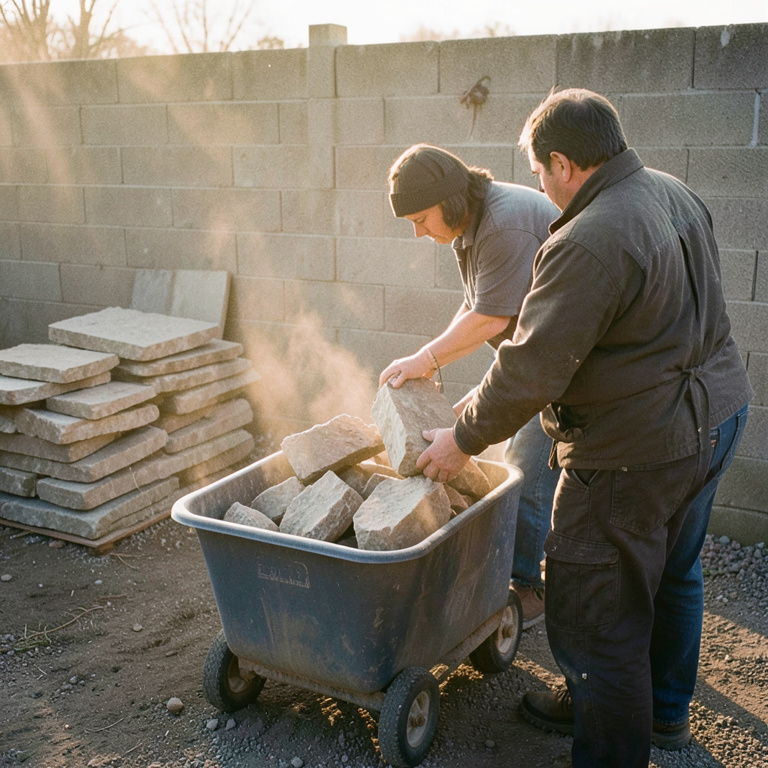
The Foss Creek Lapidary Society's specimen intake procedure is correct, and this spring it was followed to the letter. Incoming material is logged by an officer, assigned a locality, and either accepted into the club case or returned to the field. Tony Davis, the society's registrar for eleven years, executed every step. The locality column reads, in his handwriting, "The Dumpster."
The material arrived as cut-offs: the triangular end pieces a stonemason discards when squaring a limestone sill, the offcut corners of a quartzite countertop, the slug left when a granite threshold is cut to length. They are flat on one face, sawn clean, and heavy in the hand in a way that reassures. They are also, geologically, the leftover of a quarry someone else already opened with a truck.
Davis does not see a problem. "A rock is a rock," he said, arranging four slabs by size on the meeting table. "You can tell a lot from a sawn face. You can't tell much from a broken one." He streaked one across an unglazed plate — pale buff, no trace — and set it down with the certainty of a man closing a ledger.
The club's provenance rules, drafted in 1994 after a dispute nobody now remembers clearly, require that a specimen's origin be stated plainly rather than embellished. The rule is being followed, and the rule is correct. It was never designed to meet an enthusiast's passion for a filled trunk, because it assumed the trunk came from somewhere.
Carla Sullivan, who chairs the acquisitions subcommittee, inspected the intake log for twenty minutes and found no violation. "It says where it came from," she said. "It says the dumpster. I've seen worse entries. I've seen entries that were lies." She noted that sawn material spares a hobbyist with a trim saw the risk of breaking a specimen to see its interior — a consideration the subcommittee considers material to the vote.
Jackie Watson, who maintains the display case's locality index, has spent three weeks attempting to assign a county. She has ruled out three. "I can tell you it isn't from the Cretaceous outcrop north of town," she said. "That's a negative. Negative provenance is still provenance, but it doesn't fit on the card."
Marjorie Tate read the previous meeting's minutes aloud, including the motion to accept forty-one pieces of sawn limestone, with a dramatic pause before the locality. The one question was whether the dumpster was in town. Davis said it was behind the mason's yard on the service road, which is not a collecting site and not a site anybody was encouraged to visit. Several members already knew where it was.
At the September meeting the society voted to accept a second delivery, this one granite. The vote was unanimous. Sullivan noted that the material had been washed. Watson noted that it still has no county.
The club's annual report lists "construction waste" as its largest donor.
Comments
No comments yet. The commenters are thinking.